
Actress Meena Kumari- Her Story
Meena Kumari remains one of the most respected actresses in the history of Indian cinema. She was known for her powerful performances, expressive eyes, graceful presence, and ability to portray deep emotions. During a career that lasted several decades, she appeared in many successful films and created characters that remain memorable even today. Her performances often showed love, loneliness, sacrifice, pain, and inner strength. Because of her remarkable talent in portraying sorrow, she became popularly known as the “Tragedy Queen” of Hindi cinema.
Early Life
Meena Kumari was born as Mahjabeen Bano on August 1, 1933, in Bombay, British India. She came from a family connected with the performing arts. Her father, Ali Bux, worked as a theatre artist and musician. Her mother, Iqbal Begum, had also been associated with the entertainment world.
The family faced financial difficulties, so Meena Kumari entered films at a very young age. Her childhood was therefore very different from that of most children. While other children went to school and enjoyed their early years, she spent much of her time working on film sets.
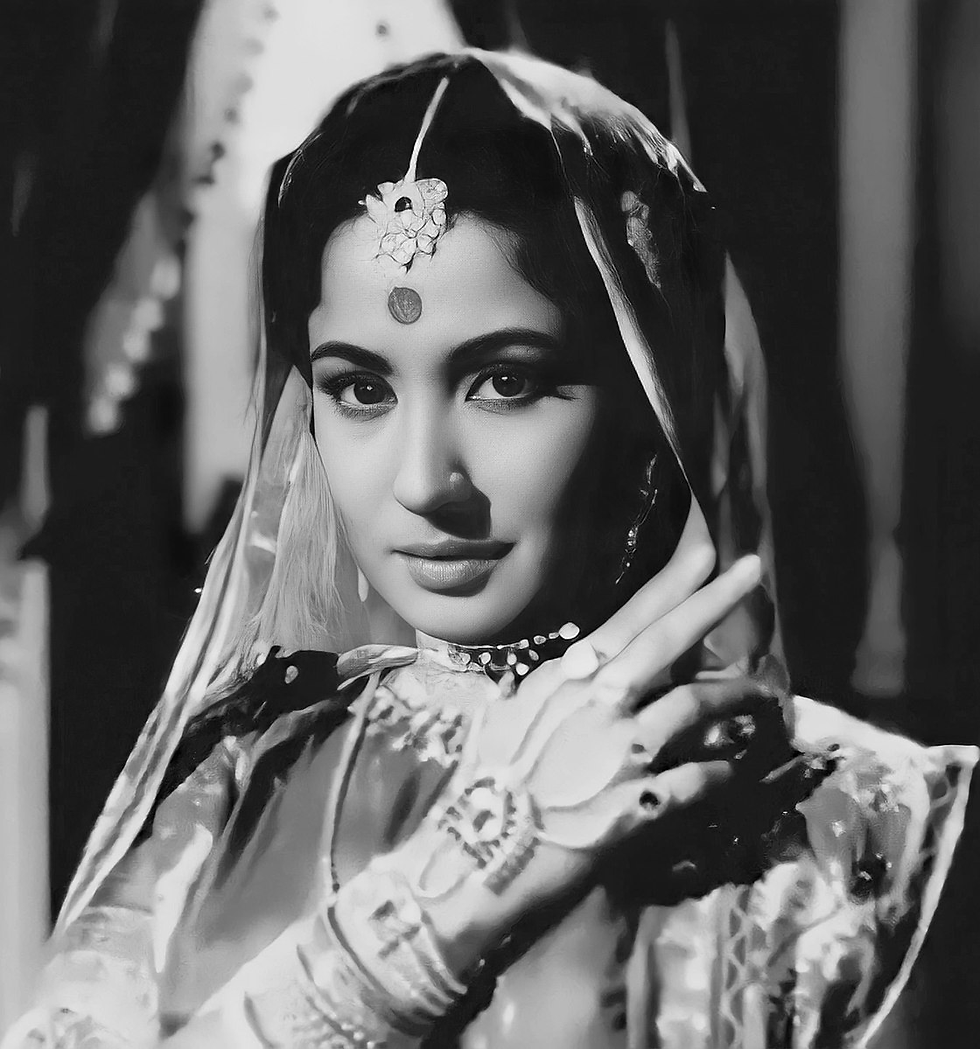
She began her career as a child artist. Her early screen appearances helped her learn the technical and emotional aspects of filmmaking. She gradually developed confidence in front of the camera. Her experience as a child artist later helped her become a mature and disciplined performer.
Beginning of Her Film Career
Meena Kumari worked in several films as a child artist. She appeared under the name Baby Meena. During these early years, she gained valuable experience and learned how actors worked with directors, cameramen, writers, and other members of a film crew.
As she grew older, she moved into leading roles. Her transition from child artist to heroine was not easy. The Hindi film industry was highly competitive, and many actresses were trying to establish themselves. However, Meena Kumari gradually created a special place for herself through her acting ability.
Her early adult films gave her opportunities to experiment with different characters. She was not limited to one type of role. She worked in romantic films, social dramas, family stories, and emotional narratives.
Meena Kumari: Rise to Stardom
Meena Kumari’s career reached a new level during the 1950s. She became one of the leading actresses of Hindi cinema and worked with some of the finest actors, directors, writers, and music composers of the period.
One of her important films was Baiju Bawra (1952), directed by Vijay Bhatt. The film became a major success, and Meena Kumari’s performance received widespread appreciation. Her portrayal demonstrated that she could combine emotional depth with natural screen presence.
The success of Baiju Bawra established her as a serious actress. She began receiving increasingly important roles. Her ability to communicate emotions through subtle facial expressions became one of her greatest strengths.
Another significant film was Parineeta (1953), based on the famous novel by Sarat Chandra Chattopadhyay. Meena Kumari played Lalita, a sensitive and dignified woman caught in emotional and social circumstances. Her performance earned her great admiration and strengthened her reputation as a talented dramatic actress.
Pakeezah
The film most closely associated with Meena Kumari is Pakeezah. Directed by Kamal Amrohi, the film was made over many years and became one of the most famous films in Hindi cinema.
Meena Kumari played Sahibjaan, a courtesan who dreams of love, dignity, and acceptance. The film combined romance, music, poetry, elaborate costumes, and beautiful visual presentation.
The production of Pakeezah was complicated and took a long time to complete. Despite the difficulties, Meena Kumari remained closely connected with the project.
The film was released in 1972. It initially received a mixed response, but its popularity grew significantly over time. Today, Pakeezah is regarded as a classic of Indian cinema.
Meena Kumari’s performance became the emotional heart of the film. Her graceful expressions and controlled acting gave the character a lasting identity. Songs such as “Chalte Chalte” and “Inhi Logon Ne” also became closely associated with the film.
Her Acting Style
Meena Kumari had a distinctive acting style. She did not depend on exaggerated gestures to express emotion. Instead, she often used her eyes, facial expressions, pauses, and voice.
Her eyes were especially important to her performances. A small change in her expression could communicate sadness, affection, fear, or disappointment.
She also understood the importance of silence. In many of her scenes, she could communicate more through a quiet expression than through a long dialogue.
Her performances often had dignity. Even when her characters experienced difficult situations, she usually portrayed them with emotional control. This quality made her particularly effective in dramatic roles.
Her Personal Life
Meena Kumari’s personal life was often discussed by the media. She married filmmaker and screenwriter Kamal Amrohi in 1952. Their relationship later became complicated, and the couple eventually separated.
Her life was marked by professional pressures and personal difficulties. However, it is important to remember that the public image of Meena Kumari as a permanently sorrowful person was partly created by the kinds of roles she played on screen. Her real personality was more complex than her “Tragedy Queen” image suggested.
She was also interested in poetry. She wrote poems under the pen name Naaz. Her writing revealed a thoughtful and sensitive side of her personality.
Awards and Recognition
Meena Kumari was among the earliest major stars to receive repeated recognition at the Filmfare Awards. She won the Filmfare Award for Best Actress several times, including for Baiju Bawra, Parineeta, Sahib Bibi Aur Ghulam, and Kaajal.
Her awards reflected the respect she received from both audiences and the film industry.
However, awards alone cannot explain her importance. Her greatest achievement was the lasting emotional connection she created with audiences.
Her Final Years
During the later years of her life, Meena Kumari continued working despite serious personal and professional challenges. She completed Pakeezah, a project that had occupied a major part of her life.
She also appeared in films such as Mere Apne (1971), Dushman (1971), and Gomti Ke Kinare (1972). These films demonstrated that her talent remained powerful during the final phase of her career.
Meena Kumari died on March 31, 1972, at the age of 38. Her death shocked the Indian film industry. She left behind a body of work that continues to attract audiences and film scholars.
Meena Kumari: Legacy
Meena Kumari’s contribution to Hindi cinema goes far beyond the label of the “Tragedy Queen.” She was a versatile performer who could play romantic, comic, dramatic, traditional, and emotionally complex characters.
Her performances continue to influence discussions about female characters in Indian cinema. She showed that an actress could carry a film through emotional depth and subtle performance.
Films such as Baiju Bawra, Parineeta, Sahib Bibi Aur Ghulam, Kaajal, and Pakeezah remain important parts of Hindi film history. Her characters continue to be remembered because they feel emotionally human rather than simply fictional.
Meena Kumari’s career was tragically short, but her artistic impact was enormous. She transformed pain and emotion into memorable performances. Her expressive face, poetic sensibility, graceful personality, and powerful acting made her one of the defining stars of classic Hindi cinema.
Even decades after her death, Meena Kumari remains an enduring symbol of Indian cinema’s golden era. Her films continue to be watched, discussed, and admired. For generations of viewers, she is not simply an actress from the past. She is a timeless artist whose performances continue to speak to the human heart.