
Drishyam: The Conclusion, also widely referred to as Drishyam 3, is the third and final chapter of the Hindi Drishyam franchise. Directed by Abhishek Pathak, the film brings back Ajay Devgn as Vijay Salgaonkar, along with Tabu, Shriya Saran, Rajat Kapoor and Ishita Dutta. The cast also includes Jaideep Ahlawat, Prakash Raj and Saurabh Shukla. The film was released in theatres on October 2, 2026.
The third film carries enormous expectations because the earlier two movies established Vijay Salgaonkar as one of the most memorable characters in modern Hindi crime thrillers. Drishyam was built around intelligence, family protection, deception and the question of whether an ordinary man could outthink the police. Drishyam 2 expanded that idea and showed that even a seemingly perfect plan can create new complications.
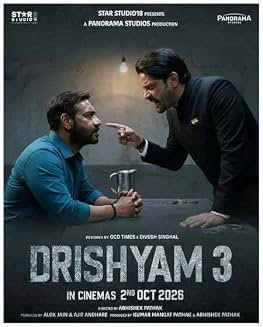
With Drishyam: The Conclusion, the filmmakers attempt to bring Vijay’s long journey to an ending.
What makes this chapter particularly interesting is that it is not a remake of the Malayalam Drishyam 3. Writer-director Abhishek Pathak developed a different story for the Hindi franchise. Pathak has explained that he wanted the third film to move away from the remake model and create something original for the Hindi audience.
The Story and the Return of Vijay Salgaonkar
The biggest attraction of Drishyam: The Conclusion is naturally Vijay Salgaonkar.
When audiences first met Vijay, he appeared to be an ordinary cable operator and devoted family man. His greatest strength was not physical power but his ability to observe people, understand situations and think several steps ahead. His love for cinema also became an important part of his personality.
The earlier films transformed this apparently simple man into someone capable of constructing an elaborate strategy to protect his family.

The third film begins with the consequences of that history still hanging over the Salgaonkar family. Vijay may have escaped immediate danger in the past, but the emotional and legal consequences of those events have not simply disappeared.
The promotional material deliberately revealed very little about the central twist. The official teaser suggested that an unexpected development has changed the situation for the Salgaonkars and asked whether Vijay and his family can outwit the system once again.
That approach is important because Drishyam has always depended on surprise.
The filmmakers understand that audiences now know Vijay extremely well. They also know the structure of the franchise. Viewers enter the theatre expecting another clever plan, another investigation and another major revelation.
Therefore, the challenge is no longer simply to create a mystery.
The real challenge is to create a mystery that can surprise an audience that has spent years analysing Vijay’s methods.
This becomes one of the film’s central strengths.
Instead of treating Vijay as an unbeatable mastermind, the third chapter places greater emphasis on the consequences of living with secrets. The family that Vijay protected has also been changed by everything that happened.
That gives the story an emotional dimension beyond the crime-thriller framework.
Ajay Devgn as Vijay Salgaonkar
Ajay Devgn remains the heart of the franchise.
His performance as Vijay has always depended on restraint. He does not need dramatic speeches or excessive expressions to communicate what his character is thinking. A look, pause or change in his voice can suggest that Vijay has already considered something that other characters have not noticed.
That quality remains particularly effective in the third film.
Vijay is fascinating because he does not look like a traditional action hero. He is not introduced as a powerful gangster, police officer or professional criminal. He is an ordinary middle-class family man who finds himself in extraordinary circumstances.
Devgn understands that contradiction.
His performance makes Vijay simultaneously sympathetic and morally complicated. The audience understands why he wants to protect his family. At the same time, his decisions raise difficult questions about truth, justice and responsibility.
That moral ambiguity has always been central to the franchise.
Is Vijay a hero because he protects his family?
Is he a criminal because he deliberately manipulates the investigation?
Can both things be true at the same time?
Drishyam: The Conclusion continues to explore those questions.
The film also benefits from Devgn’s mature screen presence. Vijay is no longer simply the clever man who has discovered a way to escape a crisis. He is a character carrying years of fear, responsibility and deception.
That makes his silence more meaningful.
Tabu and the Police Perspective
If Vijay represents one side of the conflict, Tabu’s Meera Deshmukh represents the other.
Tabu has been one of the strongest elements of the franchise since the beginning. Her character is intelligent, determined and emotionally invested in the case. She is not presented as a conventional police antagonist.
Meera believes that something is wrong.
Her determination comes from that belief.
The relationship between Vijay and Meera gives the series much of its dramatic energy. Neither character is completely foolish. Neither one is completely predictable. Their conflict works because both understand the importance of information.
In the third film, this relationship becomes even more important because the audience knows the history between them.
Tabu brings intensity without overplaying the character. Her performance works particularly well in scenes where Meera is forced to reconsider what she knows.
The film therefore does not reduce the conflict to a simple battle between a clever criminal and an honest police officer.
Instead, it creates a battle between two intelligent people who have different ideas about justice.
Shriya Saran and the Salgaonkar Family
Shriya Saran returns as Nandini Salgaonkar, Vijay’s wife.
Her role is important because the emotional centre of the franchise has always been the family.
Vijay’s actions are motivated by his desire to protect Nandini and their daughters. But protection has a price.
The family has spent years living with secrets. They cannot simply return to their old lives.
This gives Nandini a stronger emotional importance in the conclusion.
Shriya Saran’s performance works because she brings vulnerability to a family that has spent years trying to appear normal. The character has to deal with fear, uncertainty and the consequences of Vijay’s decisions.
The daughters are also important to the emotional structure of the story. Vijay’s entire journey began because he wanted to protect them. As they grow older, however, the family has to confront the fact that children eventually become adults who must understand the truth surrounding their lives.
That creates an interesting question:
Can a family remain protected when its protection depends on permanent secrecy?
The third film uses this question to give the thriller greater emotional depth.
Drishyam- The Conclusion Direction by Abhishek Pathak
Abhishek Pathak returns as director after Drishyam 2.
The biggest responsibility on Pathak’s shoulders was to make a third chapter feel necessary.
Sequels often become predictable because audiences already understand the characters and storytelling formula. A third installment faces an even greater problem.
The audience knows the universe.
The audience knows Vijay.
The audience expects twists.
The audience also knows that the filmmakers will try to misdirect them.
Pathak has therefore approached the film as a continuation of the franchise rather than simply another mystery.
One of the most interesting aspects is the decision to make the Hindi third film an original story rather than a direct remake. Pathak has said that he did not want to repeat the Malayalam story and spent substantial time developing the screenplay.
That decision gives the film its own identity.
The director also understands that Drishyam is not successful merely because it contains twists. The audience must care about the characters before the twist arrives.
Therefore, family relationships, emotional tension and psychological pressure remain important.
The Writing and Suspense
The screenplay is the most important component of any Drishyam film.
A weak screenplay would immediately damage the franchise because viewers expect intelligent storytelling.
The third film attempts to maintain the basic principles that made the earlier movies popular: information is revealed gradually, characters do not always say what they are thinking, and apparently ordinary details can acquire significance later.
The film also plays with the audience’s expectations.
Once viewers understand how Vijay operates, they begin trying to predict his next move.
The filmmakers can then use that expectation against them.
This creates a fascinating relationship between the movie and its audience.
The viewer is not simply watching Vijay.
The viewer is also trying to defeat Vijay.
That makes Drishyam different from many conventional thrillers.
The movie asks audiences to become investigators themselves.
Cinema as an Important Theme
Another interesting feature of the franchise is Vijay’s love of cinema.
Movies are not merely entertainment for him. He studies them.
He remembers details.
He understands how stories work.
That knowledge becomes part of his way of thinking.
The third film develops this idea further. Recent criticism has noted that the franchise has increasingly become a story not only about family but also about movies and storytelling itself.
This is a clever direction because Vijay’s understanding of cinema has always separated him from conventional thriller protagonists.
He is not trained as an investigator.
He does not have access to sophisticated technology.
He does not possess extraordinary physical abilities.
His weapon is information.
And cinema teaches him how stories can be constructed.
That makes Vijay both a character and, in some ways, a storyteller inside the story.
Performances and Supporting Cast
The supporting cast strengthens the film.
Rajat Kapoor returns as Mahesh Deshmukh, while Ishita Dutta returns as Anju Salgaonkar. The returning actors help maintain continuity with the earlier films.
New additions such as Jaideep Ahlawat, Prakash Raj and Saurabh Shukla bring new energy to the franchise. Prakash Raj’s casting was confirmed after Akshaye Khanna’s departure from the project, with Raj clarifying that he was not replacing anyone. (The Indian Express)
Jaideep Ahlawat is particularly well suited to a thriller because of his ability to create tension through controlled performances.
Rather than relying only on loud confrontation, the film benefits when its actors allow tension to emerge through dialogue, pauses and suspicion.
This approach suits the Drishyam universe.
Music, Cinematography and Atmosphere
Unlike an action blockbuster, Drishyam does not need constant spectacle.
Its atmosphere is more important.
The cinematography uses familiar domestic spaces, roads, police offices and public locations to create an increasingly uncomfortable environment.
Ordinary places can become threatening because the audience knows that something important may be hidden inside them.
The background score also plays an important role.
Suspense cinema requires careful control of sound. Too much music can reduce tension. Too little can make scenes feel flat.
The strongest moments therefore come when the film allows silence to work alongside the score.
The result is a thriller atmosphere that depends more on anticipation than spectacle.
Is Drishyam: The Conclusion Successful?
As a franchise finale, the film has a difficult task.
It must satisfy viewers who have followed Vijay for more than a decade while also giving the story a meaningful ending.
Early critical response has been positive, particularly toward the performances of Ajay Devgn and Tabu and the way the film attempts to close the major narrative threads.
The commercial response has also been extremely strong. The film opened on October 2 and crossed major domestic box-office milestones within its first few days. Reports on October 7 placed its Indian collection above ₹200 crore, demonstrating the enormous popularity of the franchise.
This success shows that Drishyam has become more than a remake franchise.
It has developed its own identity among Hindi-film audiences.
Final Verdict
Drishyam: The Conclusion works because it understands what audiences expect from Vijay Salgaonkar while attempting to give them something they have not already seen.
The film continues the franchise’s central ideas of family, deception, justice and storytelling. Ajay Devgn remains perfectly suited to Vijay’s restrained personality, while Tabu continues to provide a powerful counterpoint.
The decision to create an original Hindi story rather than simply adapt the Malayalam third installment is perhaps the most important creative choice. It allows the filmmakers to create their own ending for the Hindi characters.
At its best, Drishyam: The Conclusion is not simply asking whether Vijay can escape the law.
It asks whether a person can continue living normally after building his entire life around a secret.
That is what gives the conclusion emotional weight.
The first Drishyam introduced Vijay.
The second showed how difficult it was to escape the consequences of his actions.
The third attempts to answer what happens when those consequences finally return.
For audiences who have followed the Salgaonkar family from the beginning, that makes Drishyam: The Conclusion a fitting chapter in one of Hindi cinema’s most successful suspense franchises.