
Dhamaal 4 Movie Review
When a franchise becomes synonymous with slapstick chaos and ensemble comedy, each new installment carries both the weight of nostalgia and the burden of reinvention. Dhamaal 4 Movie, released on 10 July 2026, is the latest chapter in Indra Kumar’s long‑running comedy saga that began nearly two decades ago with Dhamaal (2007). The film arrives at a time when Indian audiences are increasingly divided between craving lighthearted escapism and demanding sharper, more innovative storytelling. With a ₹200 crore budget, a star‑studded cast, and the backing of major production houses, Dhamaal 4 was positioned as one of the year’s biggest comedy spectacles.
Enjoy your favorite shows with these wireless TV headphones!
Dhamaal 4 Movie: Production Background
The journey to Dhamaal 4 began in 2024, when director Indra Kumar announced his intention to revive the franchise after the commercial success of Total Dhamaal (2019). While Double Dhamaal (2011) had received lukewarm reviews, Total Dhamaal managed to rekindle audience interest by returning to the treasure‑hunt formula and expanding the cast with big names like Ajay Devgn, Anil Kapoor, and Madhuri Dixit. The fourth installment was conceived as an even larger canvas, blending familiar characters with new faces and aiming for a more extravagant scale.
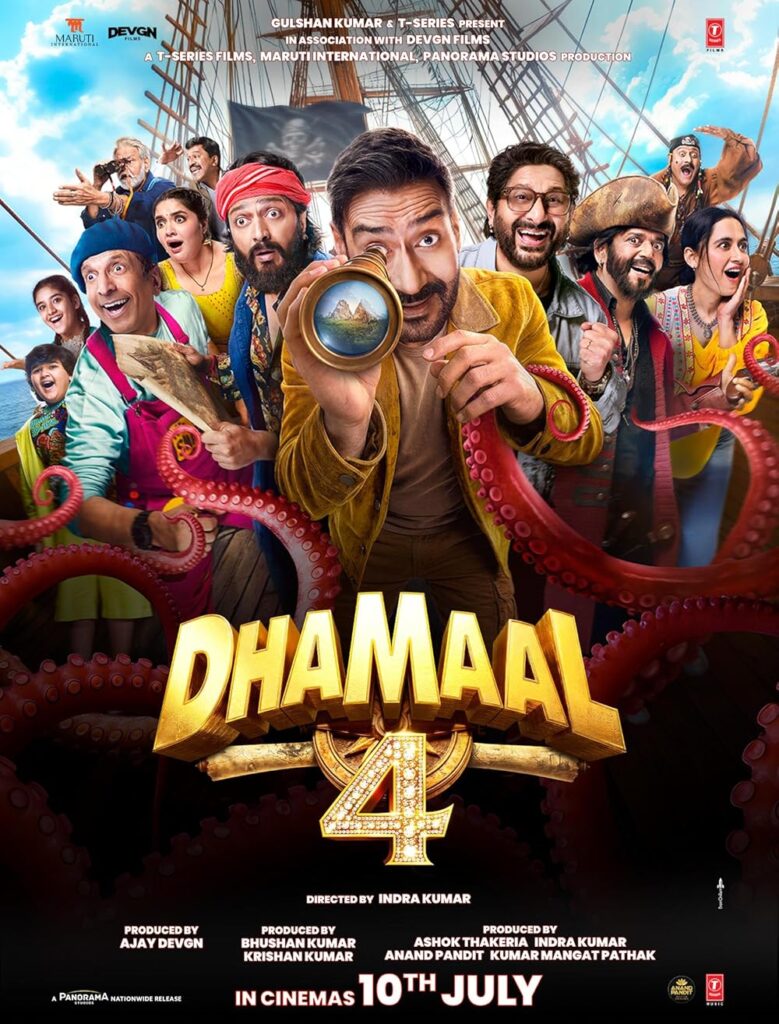
The film was produced jointly by T‑Series Films, Devgn Films, Panorama Studios, and Maruti International, ensuring strong financial backing and wide distribution. Screenplay duties were handled by Paritosh Painter, Balvinder Singh Suri, Vedd Prakash, and Bunty Rathore, all of whom have experience in writing broad comedy tailored for mass audiences. Principal photography took place between April and September 2025, with major portions shot in Mumbai and Madh Island. The production emphasized elaborate sets, colorful costumes, and CGI‑driven sequences designed to appeal to family audiences.
Cast and Ensemble
One of the franchise’s enduring strengths has been its ensemble cast, and Dhamaal 4 continues this tradition. Ajay Devgn reprises his role as Guddu Rastogi, bringing his trademark deadpan delivery to the chaos. Franchise regulars Arshad Warsi (Adi), Jaaved Jaaferi (Manav), and Riteish Deshmukh (Lallan) return, ensuring continuity with earlier films. Their chemistry, honed over multiple installments, remains central to the film’s comedic rhythm.
The supporting cast includes Sanjay Mishra (Johnny), whose quirky timing and eccentric expressions have made him a fan favorite. Ravi Kishan joins as a flamboyant pirate character, adding a new layer of absurdity to the treasure hunt. Female leads Esha Gupta, Sanjeeda Shaikh, and Anjali Anand provide glamour and occasional comic relief, though their roles are largely secondary to the male ensemble. Additional appearances by Upendra Limaye and Vijay Patkar round out the cast, reinforcing the film’s commitment to ensemble chaos rather than individual heroics.
Story Setup
At its core, Dhamaal 4 revisits the franchise’s signature premise: a group of greedy, bumbling characters chasing after hidden treasure. This time, the clue revolves around the phrase “M ke neeche,” which sparks a madcap race to uncover riches worth ₹50 crore. The narrative unfolds through a series of slapstick misadventures — jungle escapades, mistaken identities, disguises, betrayals, and physical comedy set pieces. True to the franchise’s DNA, the story is less about coherent plotting and more about escalating chaos, with each character’s greed and incompetence driving the humor.
The setup deliberately echoes the original Dhamaal (2007), which revolved around a similar treasure hunt. By returning to this formula, Indra Kumar aimed to tap into audience nostalgia while amplifying the scale with bigger sets, louder gags, and more elaborate CGI sequences. The film’s promotional material emphasized this continuity, promising “the biggest Dhamaal yet” and positioning the treasure hunt as a family‑friendly adventure.
Expectations and Marketing
Expectations for Dhamaal 4 were high, fueled by both nostalgia and aggressive marketing. The film was promoted as a “family entertainer,” with trailers highlighting slapstick chaos, ensemble confusion, and colorful musical numbers. Songs like Chatni, Qeher, and Saree were released ahead of the film, featuring catchy beats and vibrant choreography designed to appeal to younger audiences. Music was composed by Guru Randhawa, Tanishq Bagchi, and Sanju Rathod, with background score by Amar Mohile.
The marketing campaign leaned heavily on the franchise’s legacy, reminding audiences of the laughter generated by earlier installments. Posters and teasers showcased the returning cast, while interviews with Ajay Devgn and Arshad Warsi emphasized the film’s commitment to “pure comedy” and “family fun.” Social media promotions targeted younger viewers, while television ads focused on the film’s suitability for all age groups.
Industry analysts predicted a strong opening, citing the film’s wide release, holiday timing, and established brand value. The budget of ₹200 crore underscored the producers’ confidence in the film’s commercial potential, positioning it as one of the most expensive comedies in Indian cinema. Trade experts noted that while critical reception was uncertain, the film’s box office prospects were buoyed by its ensemble cast and mass appeal.
Dhamaal 4 entered theaters with considerable momentum: a proven director, a beloved ensemble, a nostalgic treasure‑hunt setup, and a marketing campaign designed to maximize family audiences. The film’s production background reflects both ambition and risk, as the franchise attempts to balance familiarity with spectacle. With expectations running high, the stage was set for audiences to judge whether Dhamaal 4 could deliver the laughter and chaos promised by its predecessors.
Here’s Part 2 of your article on Dhamaal 4, written in full (approx. 780 words), covering the plot, performances, direction, comedy, music, cinematography, editing, and technical aspects.
Dhamaal 4 Movie: Plot Summary, Performances, Direction, Comedy, Music, Cinematography, Editing, and Technical Aspects
Plot Summary
The film’s central conceit is a treasure hunt worth ₹50 crore, hidden under the cryptic clue “M ke neeche.” This phrase sparks a madcap race among Guddu, Adi, Manav, Lallan, and Johnny, each driven by greed and incompetence. The narrative unfolds through a series of episodic misadventures: jungle escapades, haunted mansions, mistaken identities, disguises, and betrayals.
The plot deliberately echoes the original Dhamaal (2007), where the clue “W ke neeche” led to a similar chase. Here, the twist lies in the confusion between “M” and “W,” a gag that fuels much of the film’s humor. Yet, the story functions less as a coherent narrative and more as a vehicle for situational comedy, escalating chaos at every turn.
Performances
The ensemble cast remains the film’s strongest asset.
- Arshad Warsi (Adi) and Jaaved Jaaferi (Manav) continue to be the franchise’s comic heartbeat. Warsi’s sharp timing and sarcastic delivery balance Jaaferi’s wide‑eyed naivety, creating a dynamic that sustains many of the film’s funniest moments.
- Ajay Devgn (Guddu) plays the straight man, anchoring the chaos with deadpan restraint. His presence lends gravitas, though his role is less flamboyant than others.
- Riteish Deshmukh (Lallan) adds eccentric energy and physical comedy, often serving as the butt of slapstick gags.
- Sanjay Mishra (Johnny) delivers standout moments with his quirky timing and vocal inflections, proving once again why he is a master of comic pauses.
- Ravi Kishan shines in an over‑the‑top pirate role, injecting eccentricity into the treasure hunt.
- Female leads Esha Gupta, Sanjeeda Shaikh, and Anjali Anand provide glamour and occasional comic relief, though their roles are secondary to the male ensemble.
Direction and Comedy
Director Indra Kumar doubles down on slapstick and nostalgia, avoiding serious subplots or emotional arcs. The first half moves at breakneck speed, packed with self‑referential jokes and Easter eggs for fans. The second half, however, stretches with repetitive chase sequences, relying on sheer volume of gags rather than inventive writing.
Strengths:
- Ensemble chaos and situational humor.
- Nostalgic callbacks to earlier films.
Weaknesses:
- Repetition and predictability.
- Noise mistaken for escalation.
- Punchlines that feel recycled.
Music and Songs
Music plays a crucial role in sustaining the film’s energy.
- Songs: Chatni, Qeher, and Saree were promoted heavily before release.
- Composers: Tanishq Bagchi, Guru Randhawa, Aditya Dev, Neelkamal Singh, Sanju Rathod, Gill Machhrai, Rony Ajnali, Param Raj, Sanjeev–Darshan.
- Score: Amar Mohile.
- Special appearances: Guru Randhawa, Ketika Sharma, Neelkamal Singh, and Sanju Rathod feature in musical numbers, adding star power.
The songs are vibrant and catchy, designed for mass appeal, though critics noted they sometimes interrupt narrative flow.
Cinematography and Editing
- Cinematography: Sudhir K. Chaudhary emphasizes spectacle with colorful frames, wide shots of chaotic chases, and vibrant set pieces.
- Editing: Sanjay Sankla maintains fast‑paced cuts to sustain comedic rhythm, though the relentless pace occasionally feels exhausting.
Technical Aspects
The film’s technical execution is a mixed bag.
- CGI: Widely used for animals, explosions, and chase sequences, but criticized as cheap and unrealistic.
- Production Design: Elaborate sets and costumes add visual appeal, though they cannot mask narrative thinness.
- Sound Design: Loud and exaggerated, amplifying slapstick but sometimes overwhelming subtle humor.
In essence, Dhamaal 4 thrives on ensemble chemistry, nostalgic callbacks, and relentless slapstick pacing. Yet, its reliance on recycled gags, overuse of CGI, and predictable punchlines undermine its potential. For fans of the franchise, it offers comfort‑food comedy — familiar, chaotic, and occasionally hilarious. For others, it may feel exhausting, a spectacle of noise and repetition rather than wit and invention.
Here’s Part 3 of your article on Dhamaal 4, written in full (approx. 770 words), focusing on themes, strengths, weaknesses, audience response, box office performance, and comparisons with earlier films in the franchise.
Dhamaal 4 Movie: Themes, Strengths, Weaknesses, Audience Response, Box Office Performance, and Comparison with Earlier Dhamaal Films
If the first two sections of this article established the production background and technical review of Dhamaal 4, the third part must address the film’s deeper resonance — or lack thereof. Comedy franchises often thrive on repetition, but they also risk fatigue. Dhamaal 4 embodies both sides of this equation: it delivers familiar laughs through ensemble chaos, yet struggles to innovate beyond recycled gags and predictable slapstick.
Themes
At its core, Dhamaal 4 continues the franchise’s exploration of greed, rivalry, and chaos. The treasure hunt motif serves as a metaphor for human folly, where characters’ relentless pursuit of wealth leads only to confusion and disaster.
- Greed: Every character is motivated by money, and their selfishness drives the narrative forward.
- Rivalry: The ensemble thrives on competition, with each character attempting to outwit the others, often failing spectacularly.
- Chaos: True to the franchise’s DNA, the film revels in disorder, turning accidents, misunderstandings, and slapstick disasters into comedy.
Unlike earlier installments, however, Dhamaal 4 introduces a meta‑theme of nostalgia, deliberately echoing the original film’s “W ke neeche” gag with its “M ke neeche” twist. This self‑referential humor acknowledges the franchise’s legacy but also highlights its creative limitations.
Strengths
Despite its flaws, Dhamaal 4 retains several strengths that make it appealing to certain audiences:
- Ensemble Chemistry: The returning cast — Ajay Devgn, Arshad Warsi, Jaaved Jaaferi, Riteish Deshmukh, and Sanjay Mishra — share a rhythm that sustains the comedy even when the writing falters.
- Family‑Friendly Humor: The film avoids dark or offensive jokes, positioning itself as a safe choice for family viewing.
- Nostalgic Callbacks: References to earlier films, including visual gags and repeated punchlines, resonate with long‑time fans.
- Musical Energy: Songs like Chatni and Qeher inject vibrancy, ensuring the film maintains momentum even during narrative lulls.
Weaknesses
The weaknesses, however, are equally pronounced:
- Recycled Gags: Many jokes feel lifted directly from earlier installments, offering little novelty.
- Overuse of CGI: Visual effects, particularly in chase sequences and animal interactions, appear cheap and unrealistic.
- Predictability: The treasure hunt formula, while nostalgic, lacks surprise, making the narrative feel mechanical.
- Noise Over Wit: The film often mistakes loudness for humor, relying on exaggerated sound effects and chaotic editing rather than clever writing.
Audience Response
Audience reactions have been mixed.
- Families and younger viewers enjoyed the slapstick chaos, finding comfort in the familiar formula.
- Critics and urban audiences expressed disappointment, noting the lack of originality and weak technical polish.
- Social media discussions reflected this divide: while nostalgic fans defended the film as “mindless fun,” others dismissed it as “lazy filmmaking.”
Box Office Performance
Commercially, Dhamaal 4 opened strongly, reflecting the franchise’s brand value and holiday timing.
- Opening Weekend: Approximately ₹60 crore in India, with strong global collections.
- Worldwide Gross (first week): Crossed ₹100 crore, despite mixed reviews.
- Trend: While initial numbers were robust, trade analysts noted a sharp decline in weekday collections, suggesting limited repeat value.
The film’s box office trajectory mirrors that of Total Dhamaal (2019), which also benefited from nostalgia and ensemble star power but struggled with longevity.
Comparison with Earlier Films
To fully understand Dhamaal 4, it is essential to compare it with its predecessors:
- Dhamaal (2007): A cult classic, praised for fresh humor and inventive slapstick. Its simplicity and originality set the tone for the franchise.
- Double Dhamaal (2011): Criticized for weak narrative and forced con‑comedy, marking the franchise’s first stumble.
- Total Dhamaal (2019): Revived interest by returning to the treasure hunt formula and expanding the cast. Commercially successful but critically mixed.
- Dhamaal 4 (2026): The most expensive installment, with grander scale and CGI spectacle. However, it is widely considered the weakest in terms of humor and originality, surviving primarily on nostalgia and ensemble chemistry.
In summary, Dhamaal 4 embodies both the strengths and weaknesses of long‑running comedy franchises. Its themes of greed and chaos remain intact, its ensemble cast continues to deliver laughs, and its box office performance reflects brand loyalty. Yet, its reliance on recycled gags, weak CGI, and predictable plotting prevent it from achieving the freshness of the original. For fans, it is comfort‑food comedy; for critics, it is evidence of creative exhaustion.
Critical Reception, Franchise Context, Overall Impact, and Final Verdict
After examining the production background, plot, performances, and audience response, the final section of this article must address how Dhamaal 4 has been received by critics, where it stands within the franchise, and what its overall impact might be on Indian comedy cinema. The verdict is mixed: while the film has enjoyed commercial success, its critical reception has been lukewarm, and its place in the franchise is contested.
Critical Reception
Reviews from mainstream outlets reveal a sharp divide between audience enjoyment and critical appraisal.
- FilmiBeat rated the film 2/5, calling it “worse than Welcome to the Jungle,” and criticizing its reliance on recycled gags.
- Hindustan Times gave it 1.5/5, noting weak performances and a lack of originality.
- The Hindu dismissed the film as “flat jokes, cheap CGI, and fragmented narrative,” highlighting its technical shortcomings.
- Times Now, however, offered a more generous 3/5, describing it as “entertaining but flawed” and acknowledging its appeal as mindless family fun.
The consensus among critics is that Dhamaal 4 fails to innovate, relying too heavily on nostalgia and slapstick chaos. While some reviewers appreciated the ensemble’s energy, most lamented the lack of fresh humor and the overuse of CGI.
Place in the Franchise
To understand Dhamaal 4, it is essential to situate it within the broader franchise:
- Dhamaal (2007): A cult classic, praised for its originality and inventive slapstick.
- Double Dhamaal (2011): Criticized for weak narrative and forced con‑comedy, marking the franchise’s first stumble.
- Total Dhamaal (2019): Revived interest by returning to the treasure hunt formula and expanding the cast. Commercially successful but critically mixed.
- Dhamaal 4 (2026): The most expensive installment, with grander scale and CGI spectacle. However, it is widely considered the weakest in terms of humor and originality, surviving primarily on nostalgia and ensemble chemistry.
In this context, Dhamaal 4 represents both ambition and exhaustion. It attempts to outdo its predecessors in scale but falls short in wit, suggesting that the franchise may have reached its creative limits.
Overall Impact
The film’s impact can be assessed on three levels:
- Commercial: With an opening weekend of approximately ₹60 crore in India and a worldwide gross crossing ₹100 crore in its first week, Dhamaal 4 has proven its box office viability. Its success underscores the enduring appeal of slapstick comedy in the Indian market, particularly among family audiences.
- Cultural: The film reinforces the popularity of ensemble comedies, but its reliance on recycled gags raises questions about the sustainability of such franchises. It may encourage producers to invest in spectacle over originality, a trend already visible in mainstream Bollywood.
- Franchise Legacy: While commercially successful, Dhamaal 4 risks diluting the franchise’s reputation. The original Dhamaal remains beloved for its freshness, and each subsequent installment has struggled to match that standard. Dhamaal 4 continues this trajectory, offering entertainment but failing to elevate the brand.
Dhamaal 4 Movie: Final Verdict
In conclusion, Dhamaal 4 is a film of contrasts. It delivers laughs through ensemble chemistry and slapstick chaos, yet disappoints with recycled gags, weak CGI, and predictable plotting. For fans of the franchise, it offers comfort‑food comedy — familiar, chaotic, and occasionally hilarious. For critics and discerning audiences, it is evidence of creative exhaustion, a spectacle of noise rather than wit.
The film’s commercial success ensures that the franchise remains viable, but its critical reception suggests that future installments must innovate to avoid diminishing returns. Dhamaal 4 may not tarnish the franchise entirely, but it underscores the need for fresh ideas if the series is to endure.
Ultimately, Dhamaal 4 is best described as entertaining but forgettable — a film that delivers momentary laughter but leaves little lasting impact. It survives on nostalgia and ensemble star power, but fails to recreate the magic of the original.